


Reflection and Breaking Boundaries – Rethinking Approaches to Animal Protection

Building Capacity for the Future, Protecting Wildlife Together

CODEN: MAHJAQ ISSN: 2805-5500 (Online)

CODEN: MAHJAQ
ISSN: 2805-5500 (Online)
Creative Commons Attribution CC BY 4.0

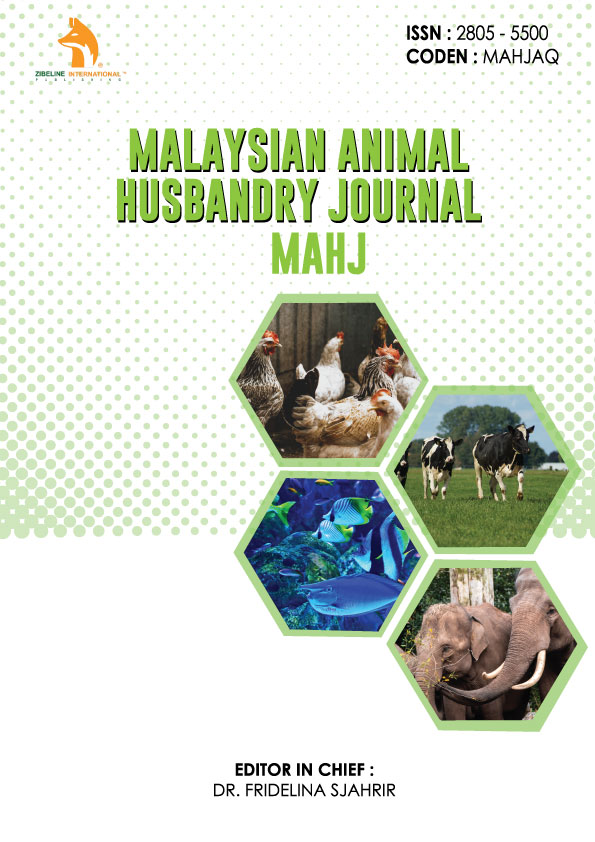
Malaysian Animal Husbandry Journal (MAHJ)

This is an open access journal distributed under the Creative Commons Attribution License CC BY 4.0, which permits unrestricted use, distribution, and reproduction in any medium, provided the original work is properly cited

Animal husbandry is the branch of agriculture concerned with the breeding, care, and management of domesticated animals for purposes such as food, fibre, milk, eggs, labour, sport, and research. It involves day-to-day care, selective breeding, proper nutrition, housing, and disease control to enhance productivity and quality. The practice has a long history, beginning with the Neolithic Revolution around 13,000 BC when animals were first domesticated, predating crop cultivation, and by early civilizations such as ancient Egypt, cattle, sheep, goats, and pigs were already integral to farming. In Malaysia, animal husbandry is an important part of the agricultural sector, with poultry farming as the largest contributor to meat and egg supply, alongside cattle, goats, sheep, and pigs. Dairy farming, though smaller in scale, is expanding, supported by government programs that emphasize selective breeding, integration with crop farming, and sustainable practices. Modern animal husbandry in Malaysia continues to develop with advances in biotechnology, veterinary care, and biosecurity measures, aiming to ensure food security while maintaining animal welfare and environmental sustainability.

Frequency: Bi-annual

Malaysian Animal Husbandry Journal (MAHJ)

AIMS & SCOPE

Malaysian Animal Husbandry Journal (MAHJ) publishes research articles, reviews, and short communications in English on all areas of animal and poultry science, including genetics, breeding, reproduction, nutrition, physiology, behaviour, animal products, processing, and livestock economics. Full experimental details are required, and manuscripts must include ethical approval for animal research. Studies involving unnecessary pain or suffering will not be accepted.

There are no length restrictions, but full experimental details are required. Manuscripts must include ethical approval for animal research; studies involving unnecessary pain or suffering will not be accepted. Topics of interest include (but are not limited to):

Topics of Interest

Genetics, Evolution, Taxonomy, & Biodiversity
Research on animal and poultry genetics, evolution, biodiversity, and taxonomy.
Animal Physiology, Nutrition, & Development
Studies on physiology, growth, nutrition, and developmental biology of animals.
Conservation of Endangered Species
Research on protection, restoration, and management of endangered species.
Population Dynamics & Ecosystem Sustainability
Studies on predator-prey interactions, population modeling, and ecosystem management.
Behavioural & Psychological Responses
Animal responses to human activity and environmental changes.
Management of Captive & Farm Animals
Techniques and practices for managing domesticated, farmed, and captive animals.
Rehabilitation & Reintroduction
Efforts to reintroduce animals into the wild and rehabilitate populations.
Animal Ethics & Welfare Standards
Studies on ethical frameworks and welfare standards and their societal application.
Pest Management & Public Health
Animal-related pest control, animal-derived food safety, and public health research.
Ethnobiological & Cross-Cultural Perspectives
Research exploring the relationships between humans and animals across cultures.

MAHJ gives preference to interdisciplinary and transdisciplinary research that advances understanding of animals and their relationships with humans.

Peer Review Policy

All peer review is single blind and submission is online via Open Journal Systems .

Article publishing charge

There is no APC for this journal. All accepted papers shall publish FOC.

Submission charges

There are no submission charges for this journal.
Indexed In Card

Journal Metrics

Usage

  • 9,569K annual downloads/views

Google Citation

  • 0.0 (2025) Impact Factor
  • 295 (2025) Citations
  • 3.6 (2025) CiteScore
  • 0.389 (2025) H Index
  • 0.0 (2025) SNIP
Speed

Speed/Acceptance

  • 90 days avg. from acceptance to online publication

Impact

0

IMPACT FACTOR

1.42

CITEFACTOR

0.389

H INDEX

0

SNIP

Speed

0 %
ACCEPTANCE
0 days
FINAL DECISION
0 days
PUBLICATION
0 $
APC

Reach

0
VIEWS
0
FINAL DECISION
0
DOWNLOADS
0
CITATIONS

PLAGIARISM SCREENING
Journal has iThenticate plagiarism screening. Submitted articles will be screened with iThenticate software before peer review

CREATIVE COMMONS ATTRIBUTION
Creative Commons Attribution
The publication is licensed under a Creative Commons License (CC BY 4.0)

PUBLON RECOGNITION
Journal offers recognition to its reviewers through PUBLON

CROSSREF INDEXING
All contents register under Crossref contents registration with DOI

CONTRIMETRIC
Contrimetric is an integrated platform that ensures the accessibility, visibility and impact of academic works by cooperating with publishers and individuals to enhance the valuable connection between papers.